
QL Strain & Side Back Pain in Cork
Sharp pain at the side of your lower back after lifting, twisting or reaching? Your QL may be the one complaining.
The quadratus lumborum (QL) is a deep muscle on each side of your lower back, running from your bottom rib to the top of your pelvis. It helps you bend sideways, stabilise your spine and hitch your hip. When it’s overloaded, it can tighten, spasm and make it painful to stand up straight, roll over in bed or even breathe deeply.
At Oak Osteopathy in Ballintemple, Cork, and online, I help people settle QL pain quickly, then rebuild so it stops coming back.
⭐ Rated 5.0 from 200+ Google reviews · 📍 Ballintemple, Cork · 💻 Online worldwide
⭐⭐⭐⭐⭐
I literally couldn’t walk when I first went to Luke. The pain was very bad and even after the first session I had relief. I was thinking I would be months in recovery but he had me upright and back working in no time.
Pain-free, in their words
⭐⭐⭐⭐⭐
Pain was a 10 when I went first and now I am lifting weights with no pain. Best in the business.
⭐⭐⭐⭐⭐
After a few sessions with Luke, my back is completely pain free again…
Why the QL gets overloaded
The QL’s main job is side bending, and side bending is the movement most of us never train. We lift, sit and bend forward, but rarely load the spine sideways through its full range. So when you suddenly lift something awkward, carry a heavy bag on one side or twist to pick something up, a muscle that’s weak in that direction gets overloaded.
Where my training comes in
Deep, loaded side bending is one of the exercises that transformed my own back. Building strength through the full side-bending range is often the missing piece for people whose QL keeps flaring.
How I work with QL strain
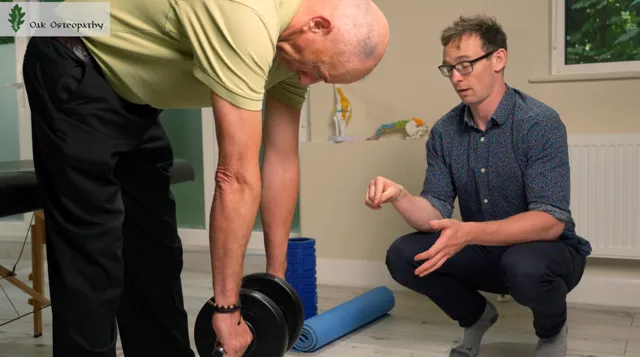
I work this way because it’s how I rebuilt my own back. Years of stretching, massage and adjustments only ever helped for a few weeks. Rebuilding movement and strength is what finally lasted, and it’s what I’ll teach you.
01. Calm the spasm
Gentle movement within what’s comfortable, positions that ease it, and hands-on treatment if it genuinely helps during a bad flare-up.
02. Restore side bending and rotation
We bring back movement in the directions your back has been guarding, from tiny ranges to full ones.
03. Load the side of the body
Progressive side bends, carries and rotation work, so the QL and the muscles around it get strong through their full range.
04. Rebuild all the main movements
Forward bending, arching back, side bending and rotation, so no direction is left weak.
What the research says
- People with back pain tend to move less, not too much. On average they move their lower back less and more slowly (Laird et al., 2014), which is why restoring movement matters.
- Rebuilding confidence in movement works. In the RESTORE trial in The Lancet, helping people move normally again led to large improvements that lasted.
- Exercise helps. A Cochrane review of 249 trials found exercise reduces chronic back pain.
When to get urgent medical help
Go to your GP or the Emergency Department straight away if you have:
- Numbness around your groin, genitals, buttocks or inner thighs
- New difficulty passing urine, or loss of bladder or bowel control
- Pain after a fall or significant accident
- Back pain with fever, unexplained weight loss or feeling generally unwell
What happens at your first appointment?
Your first session is a full 60 minutes, in the clinic in Ballintemple or online over Zoom. We talk through your history, assess how you move through bending, arching back, side bending and rotation, and start rebuilding straight away. You leave knowing what’s going on, what to do next, and with exercises that suit where you are right now.
60-minute Initial Consultation: €140
Not in Cork? I work with people all over Ireland and around the world through online coaching.
QL strain FAQs
What is the QL?
A deep muscle on each side of your lower back, between your lowest rib and the top of your pelvis. It helps you side-bend, stand up straight and keep your pelvis level.
Why does it grab when I stand up from sitting?
An overloaded QL often catches as you straighten up after sitting or bending. It usually eases once you’re moving.
Will foam rolling or massage fix it?
They can ease it for a while. Lasting change comes from getting it strong through side bending and rotation.
Related problems I help with
Ready to stand up straight again?
Start with a 60-minute Initial Consultation: €140
⭐ 200+ five-star Google reviews · 📍 Ballintemple, Cork · 🌍 Online worldwide